Pitching to sync
A supervisor asks for an upbeat track around 120 BPM in a minor key. Two filters later, a playlist link is on its way.

Your catalog lives in an old spreadsheet, three distributor exports and somebody's memory. LabelBase's music catalog management software keeps every release and track with its ISRC, credits and AI tags, ready to search, fix and pitch.
100+ releases managed monthly
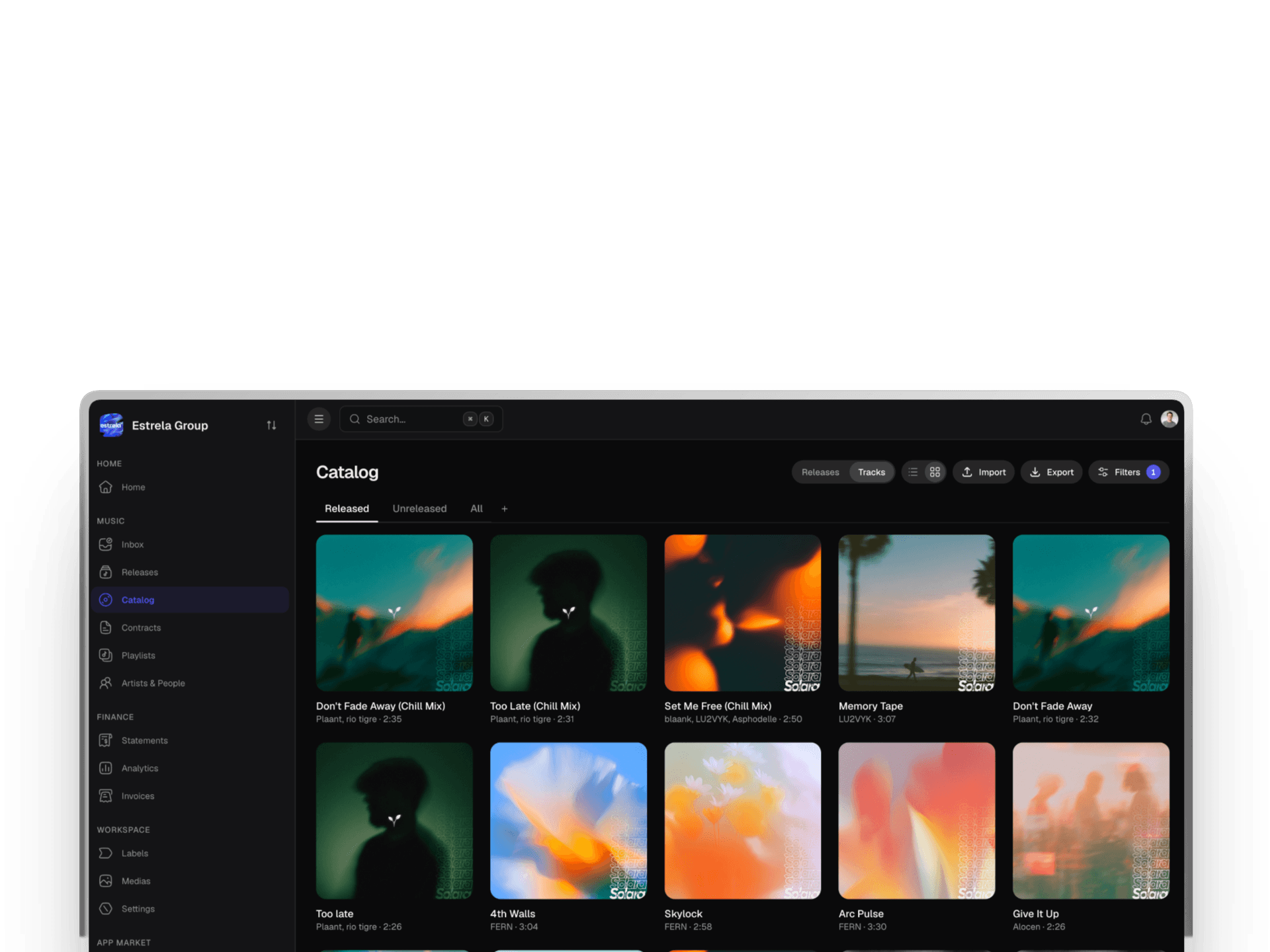
Trusted by independent labels and modern music teams











Without music catalog management software, a label's catalog is a spreadsheet nobody fully trusts, exports from past distributors, and folders of WAVs named final_v3. An ISRC typed wrong once ends up wrong at the distributor, the collecting society and in your royalty statements. And when a music supervisor asks for something upbeat in a minor key, someone has to listen through the whole back catalog.
LabelBase keeps the reference version of your music in one place: identifiers checked, every track tagged by AI, and the same catalog feeding your releases, contracts and royalties.
Every field a distributor or a collecting society will ask for, kept on the release and the track it belongs to.
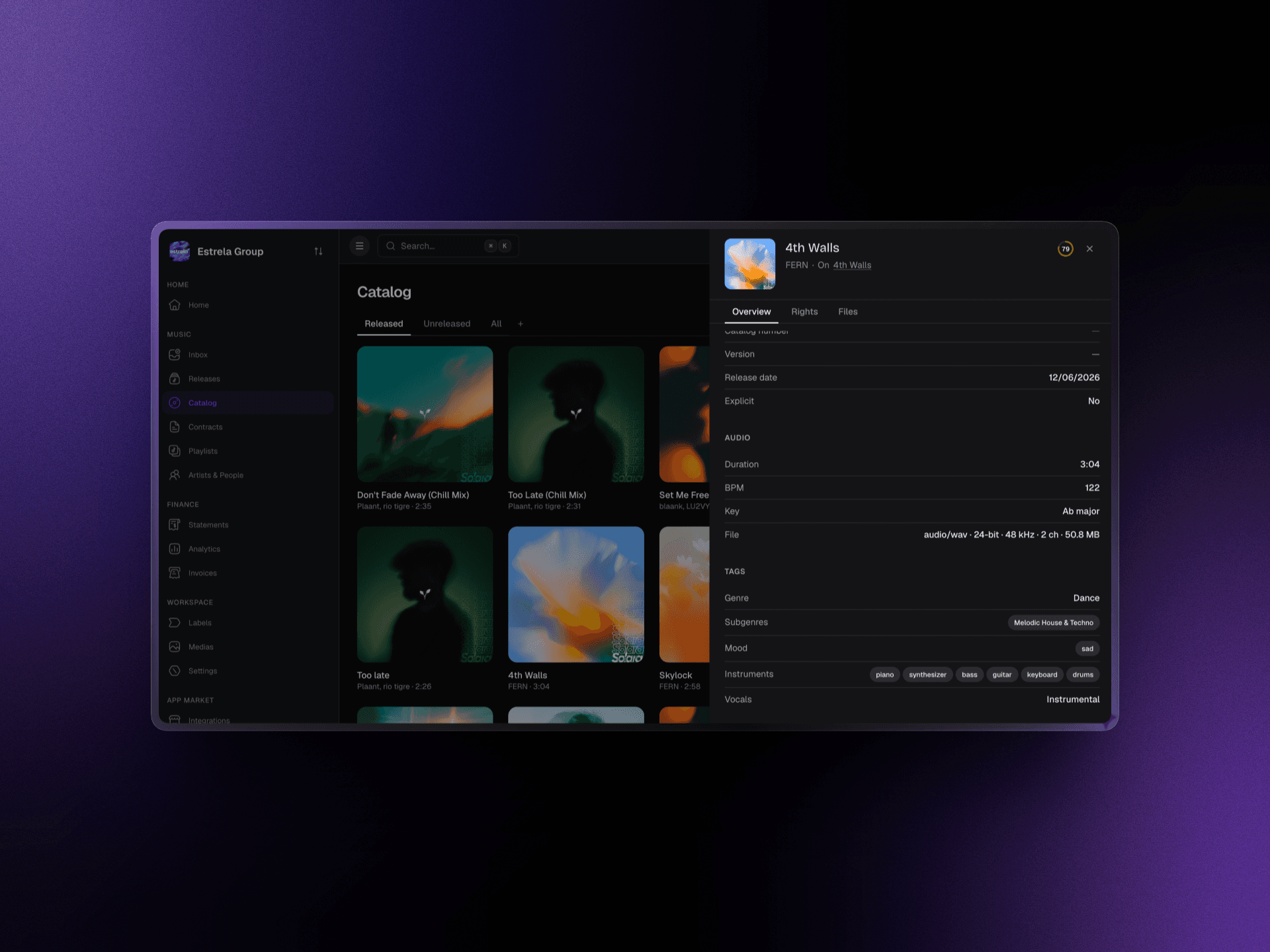
ISRCs are checked against the 12-character standard and normalised. Set your label's prefix and LabelBase generates the next one for each new track; catalog numbers follow your own sequence.
UPC, catalog number, P and C lines and cover on each release; ISRC, ISWC, language, lyrics, explicit flag, artists, remixers and writers on each track. Custom fields cover the rest.
LabelBase doesn't send DDEX messages itself: your distributor does. LabelBase keeps the metadata those messages are built from, checked before release, so what you hand over is complete.
Export the catalog as CSV or JSON for a distributor, a collecting society or an audit.
When a file lands in LabelBase, an audio model listens to it. Nobody types musical metadata by hand anymore.
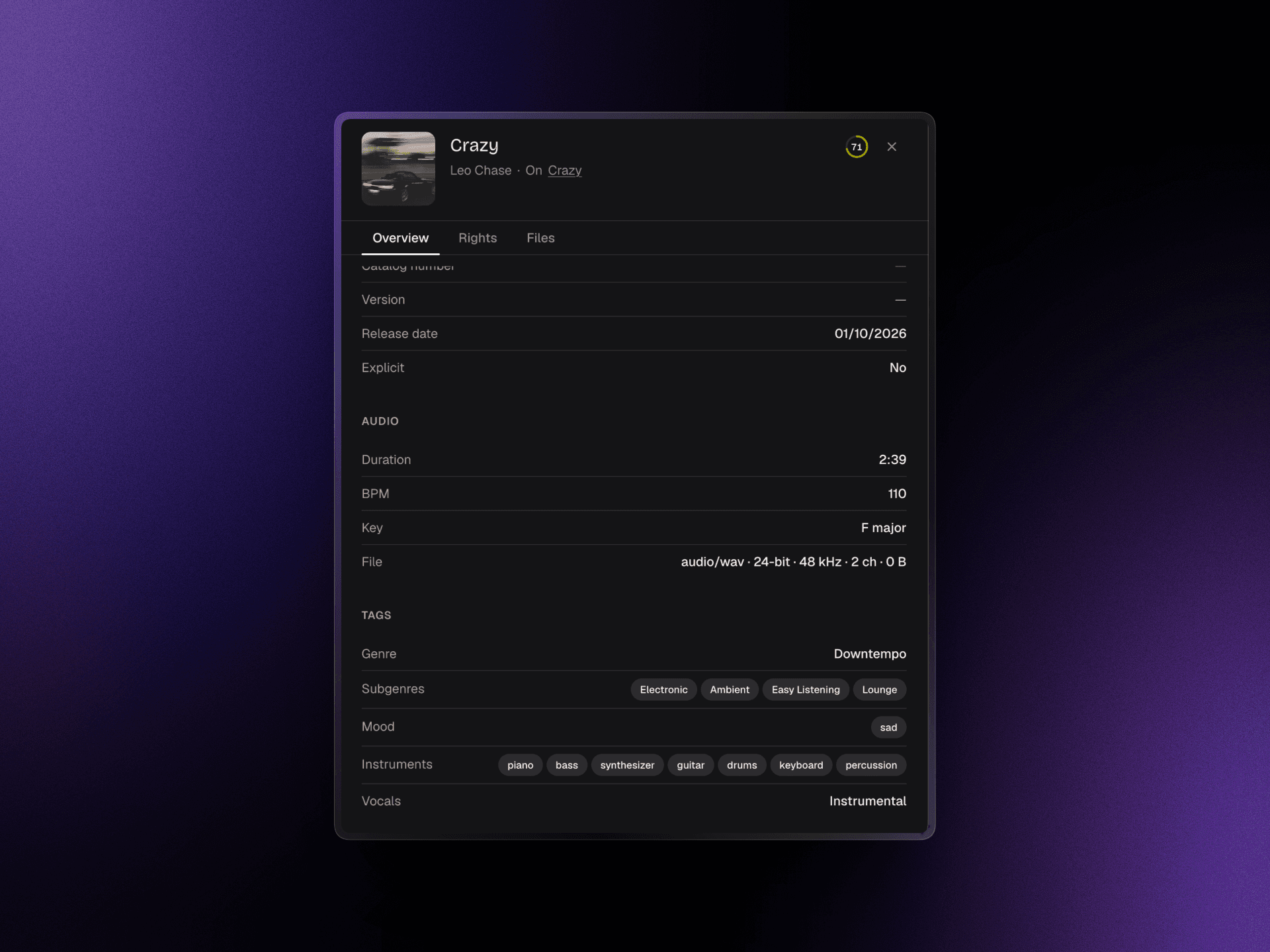
The analysis returns a genre and its subgenres, the moods the track carries, the instruments it detects and whether it has vocals.
Tempo and key are measured along with energy and loudness, so every track can be searched by how it sounds.
Pin your label's own genres and they take precedence over the model's. Every tag stays editable.
A tagged catalog answers a brief in seconds. Filter it, drop the tracks into a playlist, share it.
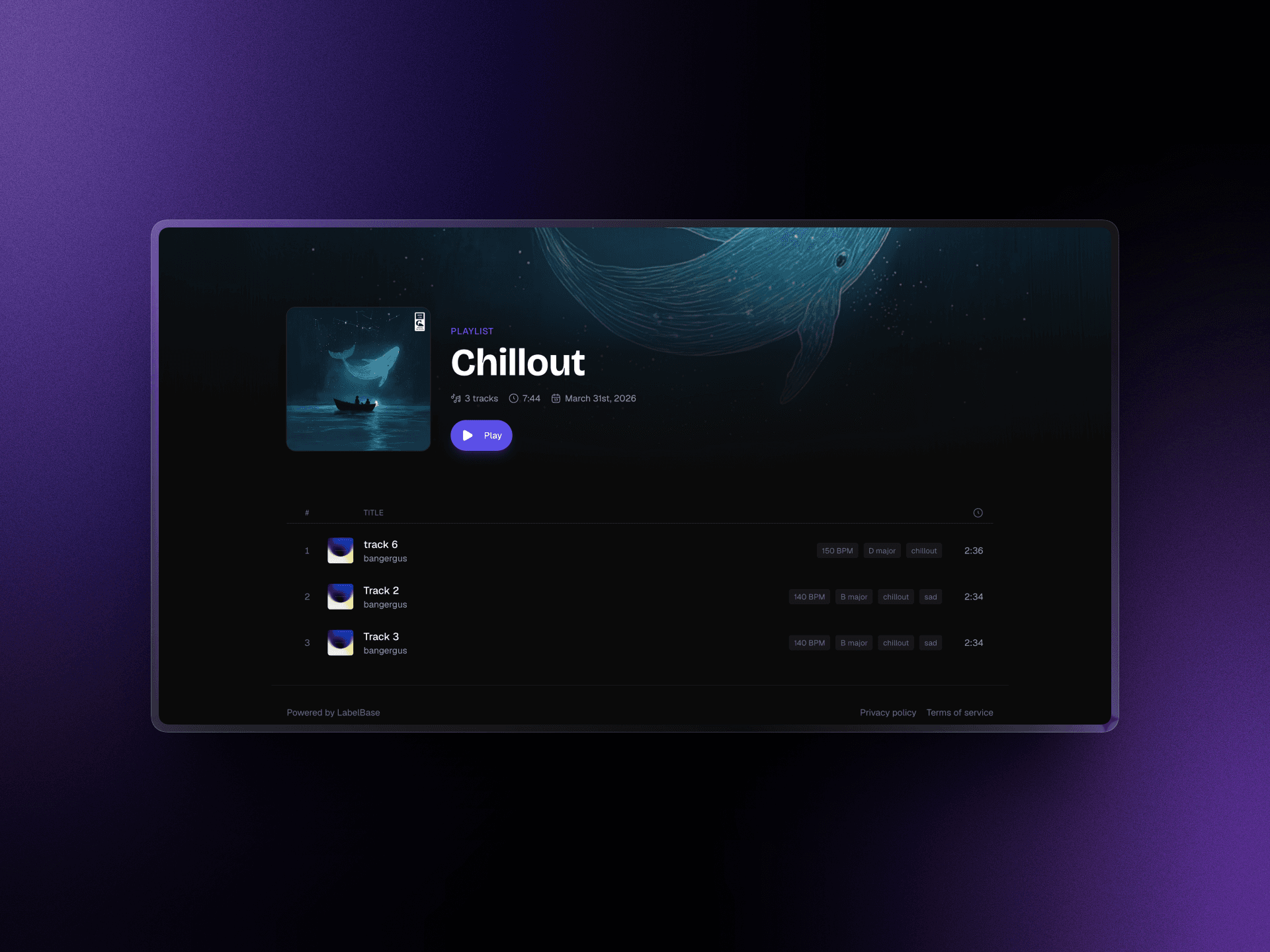
Combine name, ISRC, catalog number, genre, mood, key, BPM range, label, release status, health and your custom fields.
Drag tracks into a playlist as you browse, share it with a link, and choose whether its tracks can be downloaded.
Filter on health to find the releases missing an ISRC, a UPC, a writer or a cover, and fix them before they reach your distributor.
“We replaced Notion, Airtable, and three Google Sheets with LabelBase. Our A&R team finally spends more time listening than managing spreadsheets.”
AntonioA&R, Head in the CloudsShow us in a short call. We'll walk you through the same catalog in LabelBase, from the first import to a playlist link.
A supervisor asks for an upbeat track around 120 BPM in a minor key. Two filters later, a playlist link is on its way.
A label moving off spreadsheets sends its CSV, the team imports it, and the health score lists every track still missing an ISRC or a writer.
Statements are matched by ISRC, so a clean catalog is what makes every line of a distributor's statement land on the right track.
Not directly: LabelBase doesn't import or export DDEX ERN messages. Your distributor builds them from the metadata you provide, and LabelBase keeps that metadata complete and validated, from ISRC and UPC to credits and P and C lines.
Yes. Set your label's ISRC prefix and LabelBase generates the next code for each new track, year by year, and validates every ISRC you enter yourself.
Export it from your spreadsheet or Notion as a CSV and upload it from the Catalog page: the LabelBase team imports it for you.
Genre and subgenres, moods, instruments, vocals, BPM, key, energy and loudness. The audio analysis runs on LabelBase's own servers and your audio files are never sent to a third party.
Yes. Share the playlist with a link and choose whether its tracks can be downloaded.
It is keeping the identifiers and descriptions of every recording accurate: ISRC, UPC, ISWC, credits, writers, P and C lines, genre and mood. Distributors, stores and collecting societies rely on that data to pay you, so a missing or wrong field means revenue lost or paid to the wrong person.
Yes. Add custom fields to your tracks for anything else your label tracks, such as an internal status or a clearance note, and filter the catalog on them.
Without LabelBase
With LabelBase
ISRCs are copied by hand from one spreadsheet to the next.
ISRCs are validated, or generated from your label's prefix.
A brief means listening through the back catalog for an afternoon.
Filter by BPM, key and mood, and the shortlist is there.
Missing credits show up when the distributor rejects a release.
A health score lists what is missing before it ships.
A pitch is a zip of files sent over a transfer link.
A playlist link, with downloads on or off.
A short call with the team behind LabelBase: we look at where your catalog lives today and show you the one place that replaces it.