

Picture this: it's 11 PM. You've just received a killer demo from an artist you've been chasing for months. You want to move fast. But first, you need to find the submission template buried in a Notion page, copy the audio link into a Google Sheet you share with your A&R partner, shoot a message on Discord to loop in your team, draft a follow-up email from scratch, and then, if everything goes well, find the right contract template lost somewhere in a Google Drive folder with 47 versions named "Contract_FINAL_v3_REALLY_FINAL.docx".
Sound familiar?
This is the reality for thousands of independent music labels right now. Not because they're bad at what they do, but because no single tool was ever built for them.
The good news? That's changing. And the labels that adapt first are going to have a serious competitive edge.
The hidden cost of using 6 tools to do one job
Most independent label owners don't realize how much tool-switching is silently draining their energy and revenue. Let's do a quick audit of the average indie label's tech stack in 2026:
Discord or Slack, for team communication and demo submissions
Notion or Google Docs, for tracking releases, artists, and internal documentation
Google Sheets, for catalog management, royalties, and release schedules
DocuSign or Adobe Sign, for contracts and e-signatures
WeTransfer or Dropbox, for file sharing and audio delivery
Email, for, well, everything else
Six tools. Six logins. Six interfaces. Six places where something can fall through the cracks.
And here's the uncomfortable truth: every time you switch between tools, you lose context, lose time, and lose deals.
Studies on cognitive load show that task-switching can reduce productivity by up to 40%. Imagine reclaiming even half of that in your label workflow.
What is music label management software, and why It's a game changer
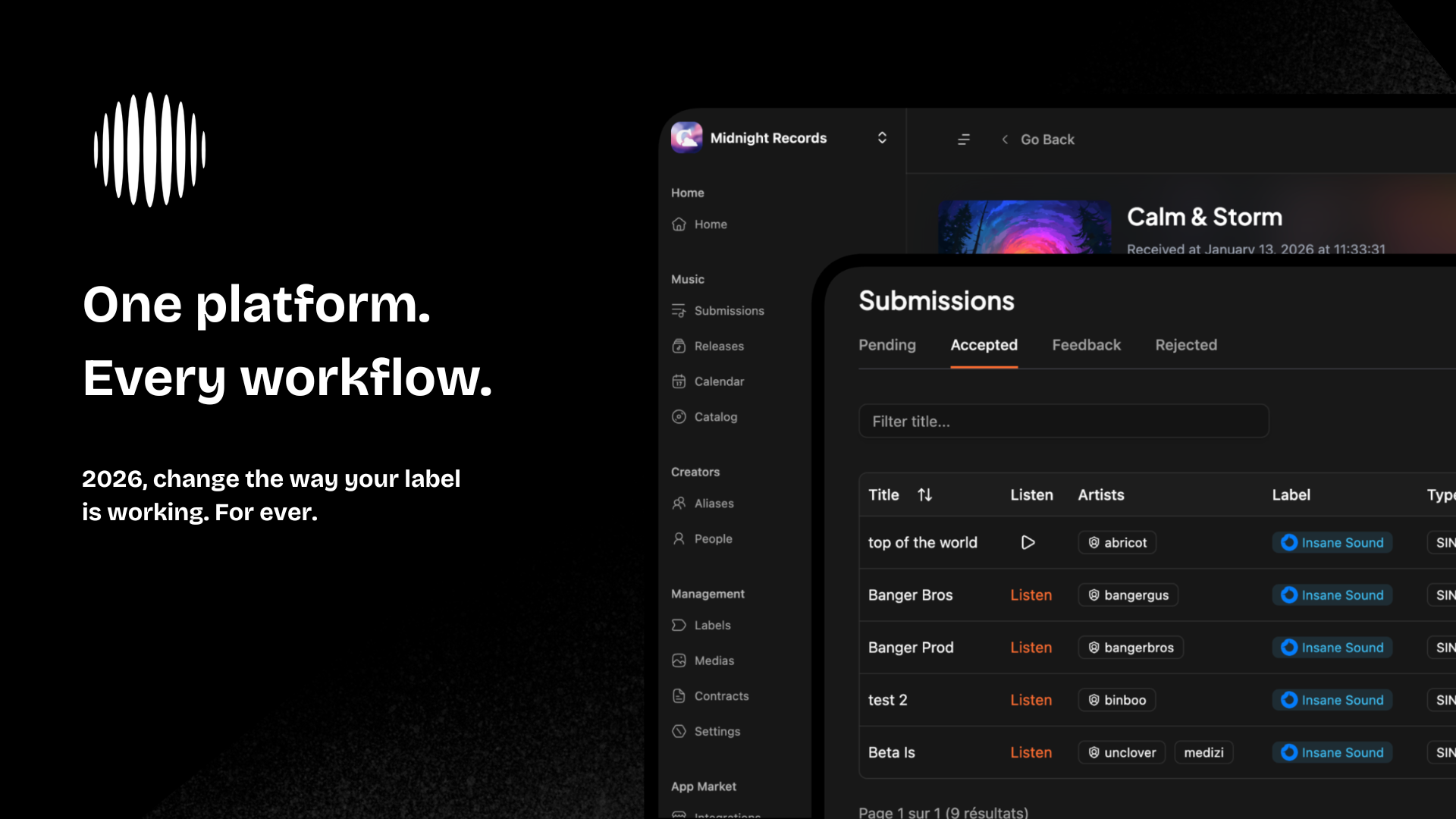
Music label management software is an all-in-one platform designed specifically for how record labels operate. Instead of patching together generic tools, it centralizes your entire workflow into a single, purpose-built workspace.
Think of it like this: imagine your A&R pipeline, artist roster, release calendar, contract system, and file management all living under one roof, talking to each other, automatically updated, and accessible in two clicks.
That's not a fantasy. That's where the industry is heading right now.
What a dedicated label platform actually covers
A modern music label management tool typically handles:
Demo submission inbox: receive, organize, and evaluate music from a centralized feed, whether submissions come via email, a web form, or even a Discord bot
Artist & release management: track every artist, every project, and every deadline without building custom databases from scratch
Contract management & e-signatures: send, sign, and archive contracts with eIDAS-compliant digital signatures, no DocuSign subscription required
Catalog management: maintain a clean, searchable library of your releases with metadata, audio files, and distribution status
Artist portals: give your artists a professional space to view their contracts, royalties, and releases without filling your inbox with "any updates?" emails
Team collaboration: comment, assign, and communicate directly on records, not in a separate chat app
It replaces your entire fragmented stack. And it does it without a learning curve built for enterprise software teams.
The real problem with Notion, Sheets, and Slack (It's not the tools themselves)
Here's something nobody wants to say out loud: Notion, Google Sheets, and Slack are great tools; they just weren't built for running a music label.
Notion is a blank canvas. That's powerful, but it means you spend hours building systems that still break when your team grows or your workflow shifts. Google Sheets is perfect for accountants, not A&R managers reviewing 200 demos a month. And Discord? Brilliant for community-building, not so much for storing contract history.
The result is a patchwork infrastructure that only you understand. What happens when you onboard a new team member? Or when you're sick for a week? Or when an artist asks a simple question about their release date and you spend 20 minutes hunting through three apps to find the answer?
Fragmented tools create fragile systems.
And fragile systems limit growth.
How label management software unlocks real scalability
Here's where it gets exciting, especially if you're thinking beyond your current label size.
When your workflow lives in one place, every process becomes repeatable. A demo comes in → it's automatically logged → your team reviews it → feedback is attached → a decision is made → a contract is triggered → it's signed → the release is added to your catalog. No copy-pasting. No manual updates. No "wait, did we send that contract?"
This kind of systematized workflow isn't just more efficient. It's what allows you to sign more artists, release more music, and grow your label without burning out.
Think of the biggest labels in the world. They don't run on Notion. They run on infrastructure — custom-built, deeply integrated, purpose-designed. Label management software gives independent labels access to that same operational leverage at a fraction of the cost.
What to look for in a music label management platform
Not all tools are created equal. Here's what separates a genuinely useful platform from another product that adds to your stack instead of replacing it:
Unified submission inbox should aggregate demos from multiple sources (email, web form, Discord) in one feed
Built-in e-signatures legally binding, no third-party account needed
Artist-facing portals professional, clean, and something you'd actually be proud to send your artists
Audio analysis features automatic BPM, key, genre, and mood detection saves hours on A&R review
Integration with tools you already use Notion, Discord, distributors — because a cold turkey switch isn't always realistic
Designed for small teams not enterprise bloat, just clean, fast, and intuitive
You can find everything on labelbase
The labels that move first will win
We're at an inflection point. Independent music is booming, but so is the volume of demos, the complexity of distribution, and the expectations artists have from their labels. The labels that will win the next decade aren't necessarily the ones with the biggest budgets.
They're the ones with the most efficient operations.
Right now, most indie labels are still running on the same stack they were using in 2018. That's your opportunity. Adopting purpose-built label management software before it becomes the industry standard puts you ahead of the curve, not just in efficiency, but in the professionalism you project to your artists, your partners, and your industry.
The chaos is optional. The tools to replace it exist right now.
Conclusion: stop managing your label in six apps
You started your label because you love music, not because you love toggling between Discord, Notion, Google Sheets, and DocuSign at midnight. Music label management software gives you back the time, clarity, and mental energy to focus on what actually matters: finding great artists and releasing great music.
The shift from fragmented tools to a unified platform isn't just a productivity upgrade. It's a strategic move that compounds over time, every workflow you streamline today saves you dozens of hours next month.
If you're ready to run your label like a serious operation, it's time to look at what dedicated software can actually do for you.
Have a look at labelbase